API Explorer
Api Explorer tool allows you to execute any of Salesforce REST or SOAP APIs in a Postman client type interface. Support for saving to APIs collections, access to standard Salesforce REST APIs and Salesforce Graphql APIs will be added in coming releases.
APIs tool can be accessed by clicking on the App Menu -> Tools -> API Explorer. Once you open the tool, it
should have created a first empty request. You can make changes to the request and then click Send which should
execute the api and show the result in the bottom panel.
API History
API History keeps a history of all the API requests you have executed. You can recall the request, explore all the details of that request as well as re-execute it.
Saved Requests
Saved Requests allow saving the API requests and execute them later. Brobench comes up with a default collection with all Salesforce Platform APIs and you can add your own custom APIs.
API Versions
API Versions allow you to create multiple variations of the same API. For ex., if you are testing an API and run into an error, then you can save that request/response as a version which you can open up later.
Variables
This version has initial support for using variables in the API URLs. Variables are enclosed between {{ and }}. For
example, {{variableName}}.
Along with standard variables, you can also use Managed Variables to define reusable values and connection-specific overrides.
Examples:
{{accountId}}whereaccountIdis configured in Managed Variables{{contactEmail}}where value can differ by connection using Connection Overrides
We support the following standard variables:
| Name | Data Type | Description |
|---|---|---|
$version | String | Current connection API Version. Connection API Version is specified in the Edit Connection dialog, defaults to latest api version supported by Brobench |
Send As (Different User)
Send As lets you execute the current API request using another connection user from the same company/tenant, without
leaving the current API tab.
- Open
App Menu -> Tools -> API Explorer. - Configure your request (method, path, headers, query/body).
- Click the dropdown arrow on
Send. - Select
Send As. - Pick a user/connection from the list.

When you Send As different user:
- API executes with the selected connection's session/access token.
- Variables are resolved against the selected connection (including managed variables and standard variables like
$version). - Response tab shows selected connection context in the label/tooltip so you can tell which user was used.
- Write requests still respect read-only connection restrictions.
JSONPath Filter
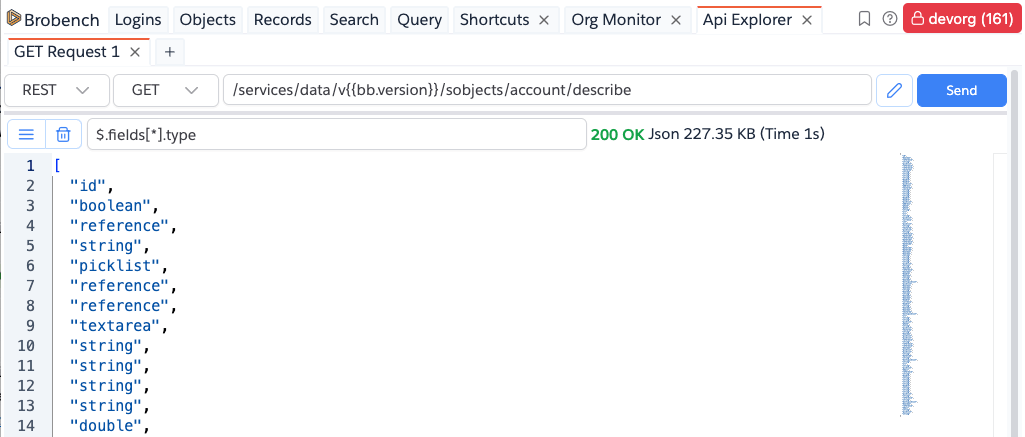
In the API Response body, you can filter the response using JSONPath. The JSONPath filter string starts with a $
character, and then it will show the response matching that JSONPath as you enter the expression.
See this page to learn more about the syntax of JSONPath.
Here is an example of JSONPath filtering.
Data Cloud APIs
Brobench supports invoking Data Cloud APIs. To invoke any Data Cloud API, select api type as Data Cloud and specify
rest of the API details like method and path etc., App also shows the Data Cloud standard API registry so you can read
and understand all Data Cloud APIs.