Event Log Files
The Event Log Files feature lets you list an org's Event Log files, download one or more files together, and view Event Log files without downloading them.
To access this feature, click on the Event Log Files tab in Org Monitor. The video guide below walks through the
feature
and its capabilities.
Overview
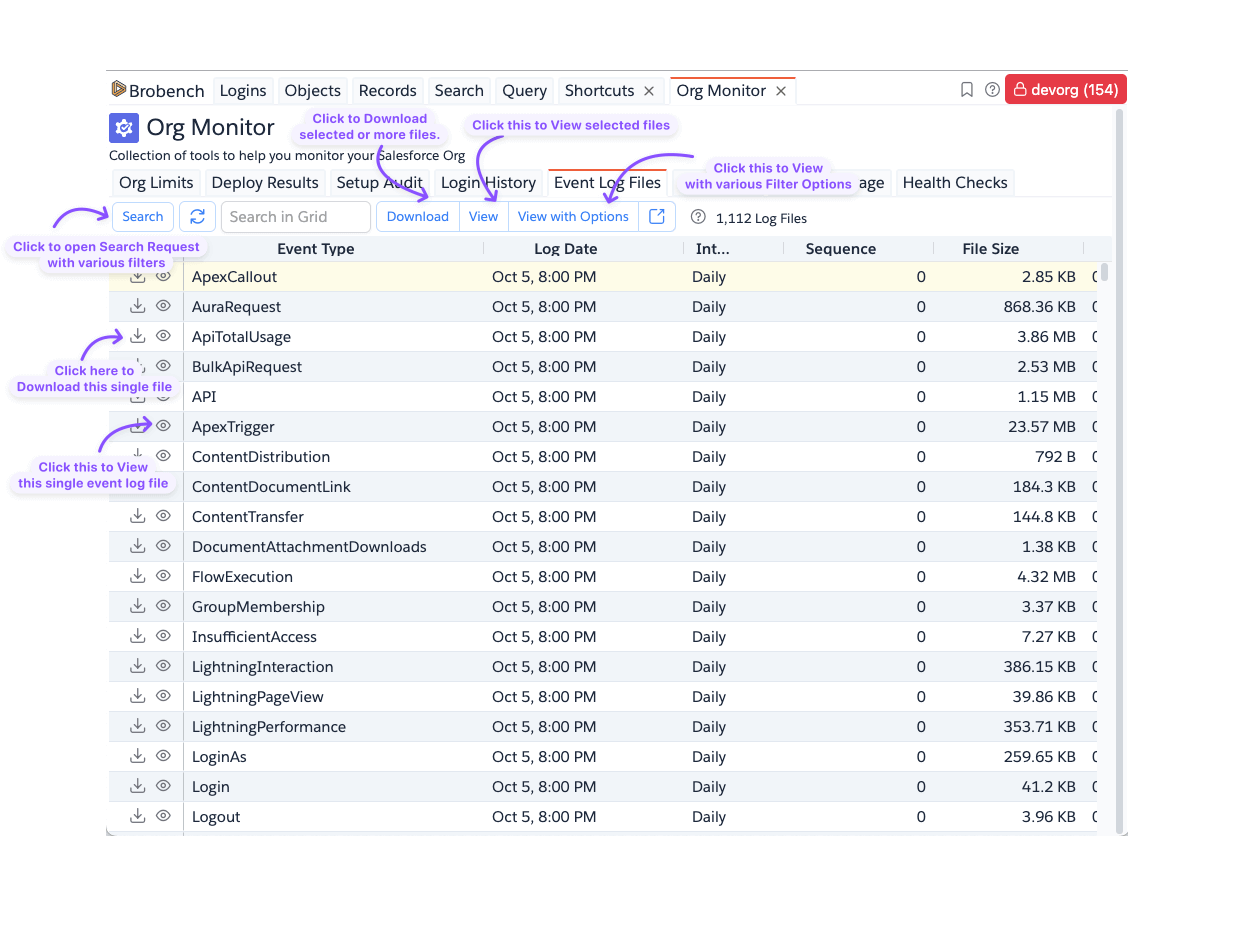
When you open Event Log Files, the app shows the following UI.
Search Request
When you click on the Search button, the app shows the dialog below. See the table below for descriptions of the
fields.

| Field | Description |
|---|---|
| Created From/Created To | Date range for the files you want to list. You can specify either or both fields. Selected timestamps are in the Brobench or Connection time zone and will be converted into UTC before constructing the SOQL. |
| Interval | Interval of files to list. It supports Hourly and Daily. Keep in mind there can be a huge number of Hourly files, so if you are listing hourly, make sure you specify other criteria like a short time window or specific Event types. |
| Event Types | Event types to list files for. You can select more than one. If none are selected, the app will show events for all types |
Download Files
To download log files, click the Download icon next to each row. Or select one or more rows and click
Download Files in the context menu or toolbar.
View Files
View Files lets you view Event Log files in a dialog without downloading and opening the CSV files in an external app. This has a few advantages.
- The app enriches
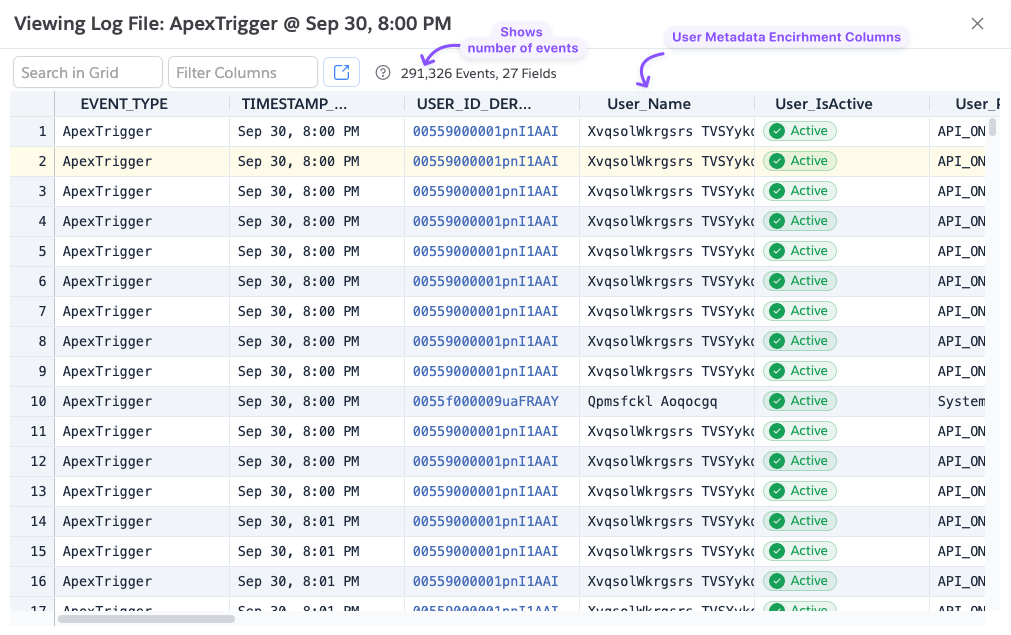
UserandReportmetadata when you view the file. You will see User Name and Profile for users, and Report Name and Folder for reports. - It lets you view multiple log files of the same type together, so if you are trying to analyze usage across a time window, you do not have to analyze the individual files and then combine the results
- The Brobench Viewer has limited capabilities compared to Excel or Google Sheets, which helps it open massive files that would typically hang other apps. How large a file you can open depends on your system resources.
- You can use Datagrid capabilities like Column Filtering and Row Grouping to analyze the data.
- You can reduce the number of rows you analyze by limiting the view to a set of users with the
Filter & Viewaction.
When you view one or more files, the app shows the dialog below. Once the data is displayed, you can search, browse, filter, and group to get the summary or insights you are looking for.
Filter and View
Event Log Files can become challenging to manage because of their high volume. For instance, if you want to locate events for a particular user over a one-week period, you would normally need to download all files for that week, review the CSV files, and extract the relevant records manually.
Brobench’s Filter & View feature streamlines this process and supports custom formulas.
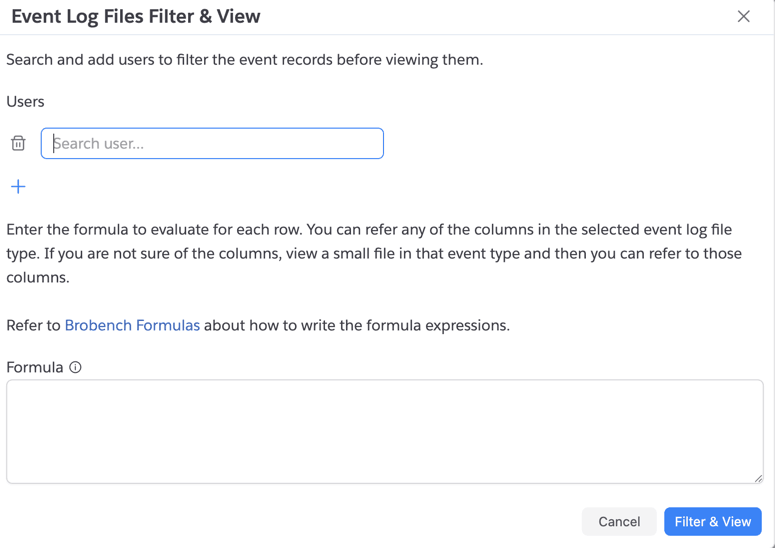
Click Filter & View to open the dialog shown below. There, you can select one or more users and enter a Brobench formula.
The app downloads the selected files, applies the requested filters, and displays only the events that match the selected users and formula.
If you are unsure which fields can be used in a formula, open a small file for that event type and note the available field names.